
words by Sophia Coor
London's art world is entering its annual hibernation. Each August, a meaningful share of Mayfair's galleries close their doors, dealers and staff scatter to the Mediterranean, and what remains on view becomes, by default, the city's entire offering until September. Before that happens, the season deserves a proper accounting, because on paper, this has been an unusually eventful few months for London's art economy, from the galleries to the sale rooms.
The summer opened, as it does most years, on several fronts at once, all within the same week in early June. Gallery Weekend came first, bringing together galleries across London for a concentrated programme of exhibitions and openings. At the same time, in Kensington Gardens, the Serpentine unveiled its 25th Pavilion, designed by Mexico City-based LANZA atelier, founded by Isabel Abascal and Alessandro Arienzo.
Marking the 25th edition of the commission, which began in 2000 with Zaha Hadid, the Pavilion takes its name from its defining architectural feature: a serpentine, or crinkle-crackle, brick wall. The form originated in ancient Egypt before being introduced to England by Dutch engineers, and is particularly associated with the orchard walls of Suffolk. Its alternating curves provide lateral stability, allowing a wall only one brick thick to stand with fewer bricks than a straight wall would require. Here, the structure also offers a subtle reference to the nearby Serpentine lake, while its permeable brickwork and translucent roof allow light, air, and movement to flow through the space.
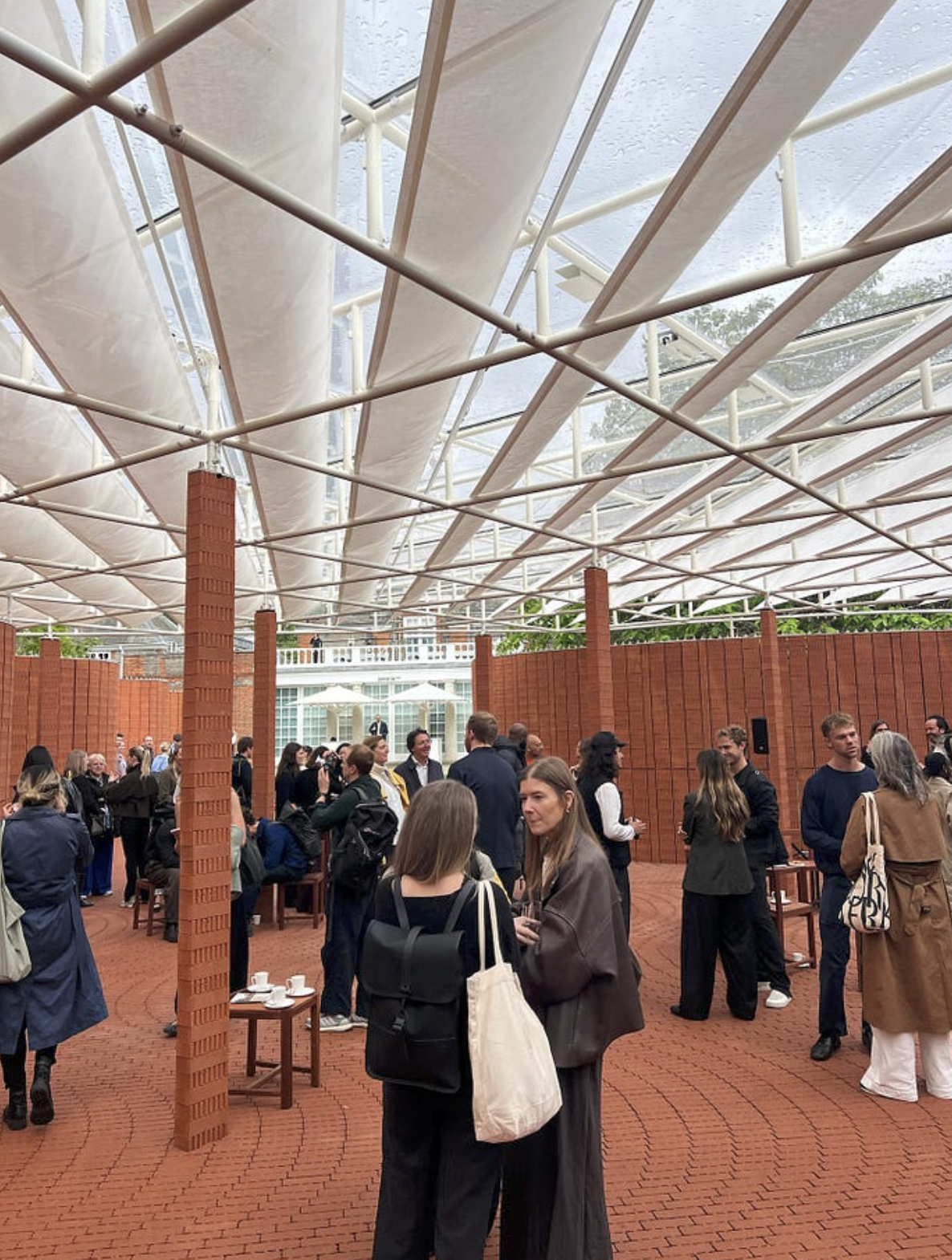
Press Preview Day - Serpentine Pavilion 2026, 'a serpentine', designed by LANZA atelier, founded by Isabel Abascal and Alessandro Arienzo
For LANZA atelier, brick was chosen both for its connection to English garden traditions and to create a dialogue with the historic brick façade of Serpentine South, itself originally built as a tea pavilion. Rather than functioning as a barrier, the Pavilion’s walls shift between opacity and openness, inviting visitors to move through and look across the structure. Throughout the summer, the Pavilion will also serve as a stage for Serpentine’s interdisciplinary public programme, bringing together music, film, theatre, dance, literature, philosophy, fashion and technology. The Pavilion is open at Serpentine South from 6 June to 25 October 2026, with Goldman Sachs supporting the commission for the twelfth consecutive year and Rolex joining this year as its Official Timepiece. To mark the 25th anniversary, Serpentine is also collaborating with the Zaha Hadid Foundation and the Architectural Association on a special programme celebrating Hadid’s legacy and the Pavilion’s history of architectural experimentation.
The Exhibition Details
So, what is actually worth seeing? Below is the selection of the exhibitions that caught my attention this summer. Some are by artists I have been following for years; others are artists whose practices I think deserve a closer look. Together, they offer a snapshot of what has felt most interesting across London's galleries this season: from painting and sculpture to questions of technology, identity, material, and art history.
George Rouy: REPRISE — Hannah Barry Gallery, until 12 September
Born in Kent in 1994 and trained at Camberwell, Rouy paints bodies that never quite hold still, stretched, fragmented, always mid-transformation rather than settled into a fixed likeness. REPRISE (the French reprendre, to take something up again) circles back to a question he keeps returning to: what happens to a body once it’s constantly being reshaped by relationships, technology, and memory. The centerpiece is a series called Procession, large figures shown being carried by others, painted in earth and mud tones; the pose echoes older religious imagery of the pietà, though the feeling is entirely contemporary. Running alongside it is a newer series, Unknown, portraits of fabricated identities used by internet bots, which reads less as commentary on artificial intelligence itself than as an observation about how easily people project feeling onto something that was never a person to begin with. Hannah Barry, the Peckham gallery that has represented Rouy since 2017 and gave him his first solo show the following year, built its reputation on identifying artists at exactly this stage. Rouy’s market has moved quickly since: in 2024, Hauser & Wirth announced joint representation of Rouy alongside Hannah Barry, opening with a show titled The Bleed in London that October, followed by a second iteration in Los Angeles in 2025 and a joint presentation at Art Basel’s Unlimited sector that June, the kind of trajectory, from a single Peckham gallery to a joint arrangement with one of the largest dealers in the world within seven years, that makes his work worth tracking and following.
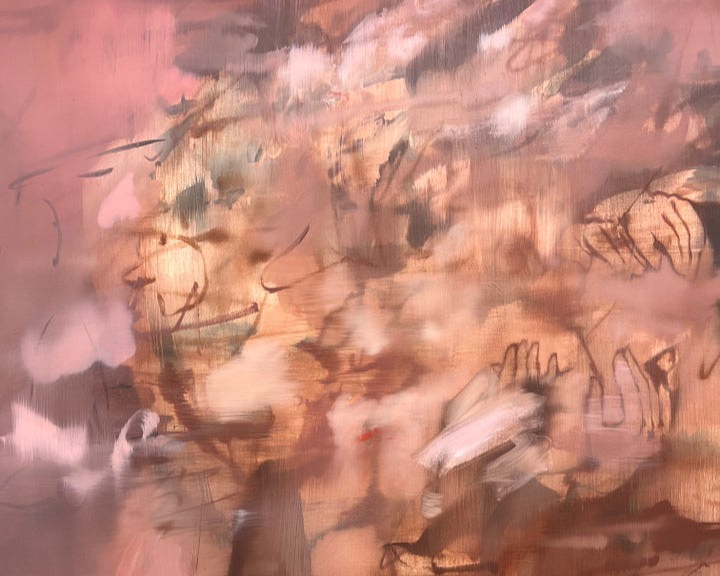
artwork by George Rouy
Anish Kapoor — Hayward Gallery, until October 18th
Anish Kapoor has returned to the Hayward Gallery for the first time in 28 years, taking over the entire building with an exhibition that brings together monumental new installations, recent works and several of the visual languages that have defined his practice for decades. It is a fitting return: in 1998, the Hayward presented Kapoor’s first major UK survey, and now, nearly three decades later, the artist has transformed the gallery once again into a space of scale, illusion, violence and wonder.
The exhibition opens with All of Nothing (2026), a vast, glossy red PVC membrane that appears to swell into the Hayward’s six-metre-high opening gallery. Too large to be apprehended in a single view, the work immediately places the visitor in the physical world of Kapoor’s sculpture: here, scale is not something to observe, but something to experience with the body. The work seems simultaneously comic, threatening and strangely organic, setting the tone for an exhibition in which Kapoor repeatedly pushes materials towards the limits of perception. From there it moves through works made with Vantablack, a material developed by the British company Surrey NanoSystems from vertically aligned carbon nanotubes that absorbs 99.965% of visible light, so dense that shapes coated in it read as flat voids rather than three-dimensional objects. Kapoor acquired exclusive artistic rights to use Vantablack in 2016, a move that provoked lasting controversy in the art world; the artist Stuart Semple responded by creating a fluorescent “world’s pinkest pink” available to anyone except Kapoor, and later legally changed his own name to Anish Kapoor as a further protest, a dispute that has run for a decade now over who gets to own access to a colour. The show closes with a room dominated by a vast red form, Ha Makom, large enough to walk partly inside. It is built to register physically rather than simply to be looked at.
Born in Bombay in 1954, Kapoor moved to London as a young man and studied at Hornsey College of Art and Chelsea School of Art. He won the Turner Prize in 1991 and was awarded India’s Padma Bhushan in 2012. His practice has since expanded across sculpture, installation and architecture, becoming synonymous with a particular ambition: to make objects that are less about representation than about altering the viewer’s perception of reality itself.
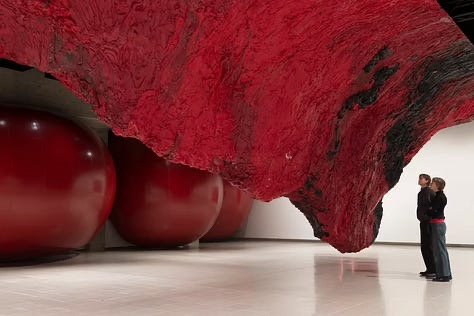
Anish Kapoor, 2026. © Anish Kapoor. All rights reserved, DACS, 2026. Photo: Dave Morgan.
John Currin: Opening Credits — Sadie Coles HQ, until 12 September
John Currin returns to Sadie Coles HQ nearly thirty years after his paintings inaugurated the gallery in 1997. Opening Credits, presented at the gallery’s new Savile Row space, brings together twelve new mid-size paintings alongside five ink drawings on washed paper and preparatory sketches. The paintings place pairs and triplets of women, with deliberately exaggerated physiques, in ornamental Arcadian landscapes. The figures are reinterpreted from 1970s clothing catalogues, while the landscapes draw on the idealised pastoral worlds of Nicolas Poussin and Jean-Antoine Watteau, as well as the more familiar terrain of Acadia National Park in Maine.
Currin has always worked at the intersection of academic virtuosity and contemporary desire, bringing the language of Old Master painting into collision with fashion, sexuality and popular imagery. Here, that tension becomes a meditation on nostalgia. The women appear as performers acting out a fantasy of an imagined golden age: a world that feels simultaneously ancient, theatrical, and contemporary.
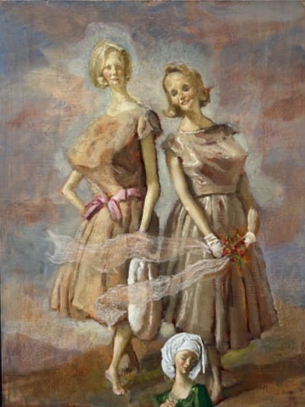
artwork by John Currin
